
Reviewed · WALKING TOURS IN AARHUS
Aarhus Walking Tour: Explore Top Sights & Hidden Gems
Aarhus reveals itself best on foot, where grand civic buildings give way to medieval lanes and quiet old streets. This two-hour walk links the city’s main sights with places such as Møllestien, a pretty cobbled lane lined with historic houses. It is a useful first look at Denmark’s second city, especially if your time is short.
I like the easy pace and the mix of major landmarks with smaller streets. I also like the chance to ask a local guide about modern Danish life, something guides including Giulia, Julia, and Kim have done particularly well. The main drawback is group size: with up to 30 people, hearing every word can be hard, and the tour may not include entry inside Aarhus Theatre or the cathedral.
Key points to know before you book
- A two-hour city introduction: The route covers central Aarhus at a manageable pace, with six named stops and a few additional surprises.
- Møllestien adds local character: This narrow cobbled street and its colorful old buildings offer a welcome change from formal monuments.
- Good for a short stay: The 10:00 start works well for a first morning in Aarhus or a port visit with limited time.
- English-speaking guides vary by date: Giulia, Julia, and Kim have each led strong tours, with clear explanations and helpful local tips.
- Large groups are the chief concern: The tour can hold 30 people, and there are no headphones listed, so standing close to the guide matters.
- Plan on exterior sightseeing: Despite the wording around the stops, at least one tour did not include going inside the theatre or cathedral.
A two-hour introduction to central Aarhus
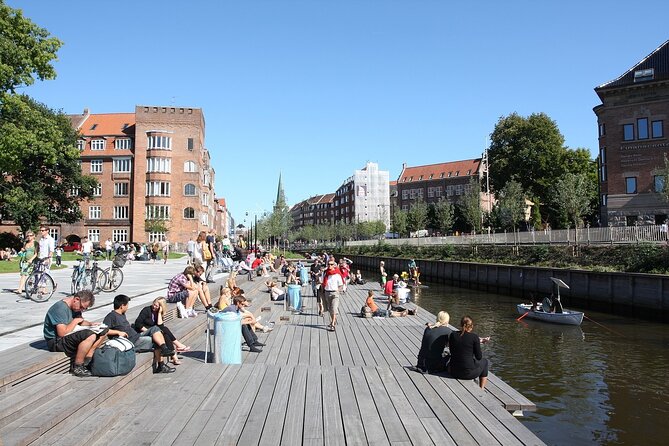
This tour is built for orientation rather than a long museum visit. You meet at Aarhus Theatre at 10:00, walk through the historic center, and return to the same meeting point after about two hours.
That format suits you if you have only one day in Aarhus, are visiting by ship, or want a clear sense of the center before exploring alone. You get the broad outline of the city, then can choose where to spend more time later.
The route is also physically friendly. The walk has been described as easy, with no hills, and most people can take part. You should still expect cobblestones in the Latin Quarter and around Møllestien, so comfortable shoes are sensible.
The price is $39 per person. That is fair if you value a guide’s background stories, local suggestions, and the chance to cover several sights without planning the route yourself. It is less attractive if you mainly want admission to interiors, since the listed stops are free and the tour does not promise paid entries.
More Walking Tours in Aarhus
- Aarhus Walking Tour: From Viking Village to Metropolis
★ 4.8 · 122 reviews - Historical Walking Tour in Aarhus
★ 4.5 · 35 reviews - Aarhus Private Walking Tour with a Local
★ 4.0 · 12 reviews
Starting beside Aarhus Theatre
Aarhus Theatre gives the tour an impressive starting point. The building has served the city’s performing arts scene since the late 19th century and remains one of the central landmarks around the meeting area.
The guide uses about 20 minutes here, which should give you time to look at the architecture and hear how the theatre fits into Aarhus’s cultural life. You may learn about the building’s role in the city, along with the contrast between classical performances and newer productions.
Do not assume that this stop includes a performance or a full interior visit. One participant found it disappointing that the theatre was not entered, despite expecting that from the description. I would book this as an exterior introduction unless the operator confirms interior access for your date.
The meeting point is Teatergaden 1, 8000 Aarhus. Arrive a little early and look for the guide carefully. Instructions have not always been perfectly consistent about identifying the guide, with references to a yellow bag and separate clothing details. The guide may arrive right at the start time rather than well before it.
Aarhus Cathedral and the old center
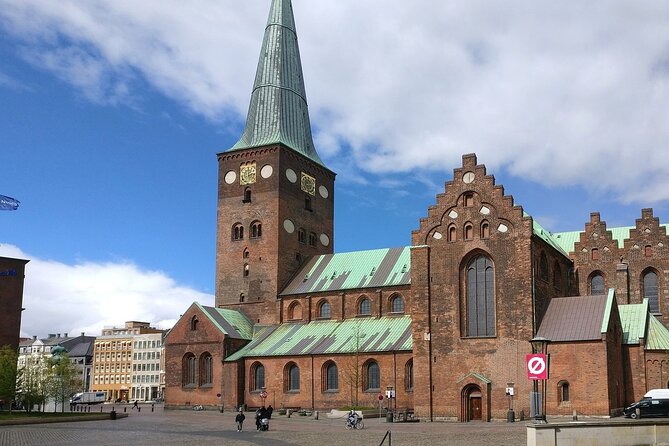
From the theatre, the walk continues to Aarhus Cathedral, one of the city’s major historic buildings. Its origins reach back to the 12th century, and it remains a place of worship as well as a major point of reference in the old center.
The cathedral is worth seeing even if your interest is mainly architectural. Its age helps explain the shape of the surrounding streets and gives context to Aarhus before the modern city spread outward.
Here again, ask about entry if seeing the interior matters to you. The tour information describes the cathedral as a stop, but actual access has not always been part of the walk. That distinction matters if you are comparing this experience with a church tour or a sightseeing pass.
A guide can add value here by explaining how religious buildings shaped Danish towns. The strongest guides on this walk have been praised for clear history and useful information for the rest of the day. Julia, in particular, has been singled out for combining local tips with an overview of the main sights.
The Latin Quarter: narrow streets and everyday Aarhus
The Latin Quarter is likely to be one of the most enjoyable parts of the route. Its narrow cobbled streets, small shops, cafes, and galleries give you a closer look at the city’s daily rhythm than a sequence of large public buildings can provide.
The name and layout point to the older side of Aarhus, while the cafes and shops keep the area current. You can expect the guide to show how old street patterns now sit alongside modern city life.
This is also where a good guide can make the difference between simply walking past attractive buildings and understanding why the area feels distinct. Ask about local habits, shopping, food, and life in Denmark today. One weakness noted by a participant was that modern cultural information did not come up until questions were asked, so do not hesitate to speak up.
The route is short enough that you can return here later. If you find a cafe or shop you like, note the street name rather than trying to linger during the group walk.
More first-timer highlights tours in Aarhus:
- Copenhagen Highlights Walking Tour
★ 5.0 · 2,324 reviews - Copenhagen: Highlights 3 Hour Bike Tour with a Local Guide
★ 4.8 · 2,312 reviews - Politically Incorrect Private Highlights Walking Tour
★ 5.0 · 1,244 reviews - Copenhagen: 3-Hour City Highlights Bike Tour with Guide
★ 4.7 · 1,239 reviews
Our Lady Church and Aarhus’s older religious landmarks
The Church of Our Lady brings another layer to the city’s religious past. Like the cathedral, it dates back to the 12th century and remains important to the local community.
Seeing both churches on the same walk helps you compare two major old religious sites rather than treating one building as an isolated monument. The guide can connect them to the development of Aarhus and its long tradition of worship.
The stop is listed at about 20 minutes, but the exact balance between explanation and walking can vary. With six named stops in a two-hour tour, you should expect a concise presentation rather than a long architectural lecture.
As with the cathedral, the safest assumption is that you will see the church and hear about it from outside unless interior entry is clearly confirmed. This is a sightseeing walk, not a dedicated church visit.
Møllestien delivers the prettiest change of pace
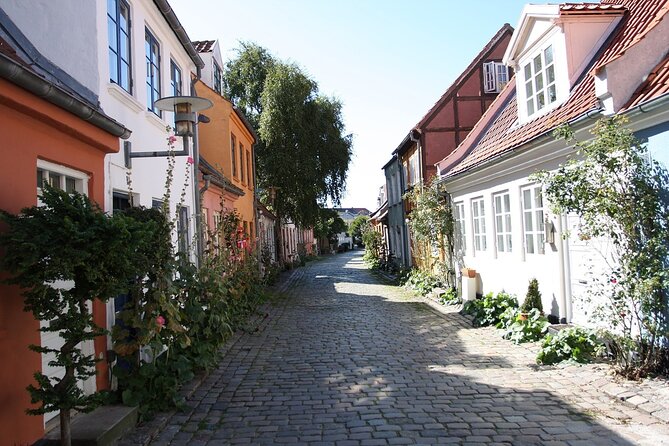
Møllestien is the route’s most picturesque street. Its cobblestones, narrow lane, colorful facades, and older houses create the sort of small-scale scene that can be missed when you stick to Aarhus’s main squares.
The street dates from the 18th century and offers a glimpse of the city’s architectural past without requiring a museum ticket. It is a good place for photographs, though the lane is narrow, so be considerate of residents and other people walking through.
I especially like this stop because it gives the tour texture. The cathedral and City Hall explain the public face of Aarhus. Møllestien shows a quieter residential side.
The word historic should not make you expect a preserved open-air museum. This is still part of a living city. The value comes from seeing old buildings in an ordinary neighborhood, not from a staged display.
Aarhus City Hall and the modern civic center
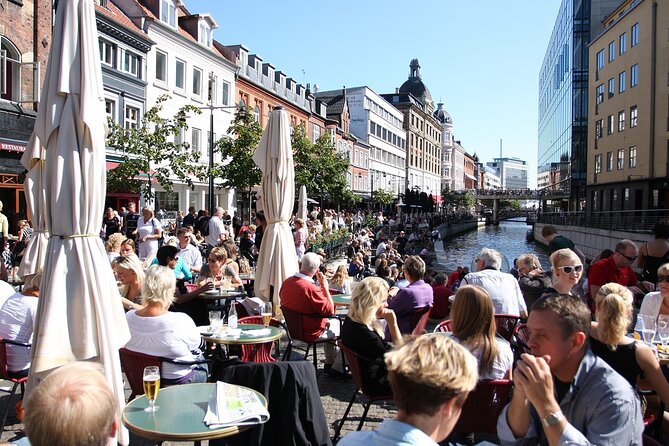
Aarhus City Hall provides a useful counterpoint to the medieval quarter. The stop shows how the city moved from old religious and commercial streets toward modern civic design.
The supplied details do not specify how much of the building you enter, so plan on an exterior visit and a guide’s explanation. The tour may include additional stops kept as surprises, which can make the final part feel less predictable.
One guide, Kim, ended the walk at the top of the Salling Department Store, where an outdoor cafe space offered views over the city. That stop is not guaranteed as part of every departure, but it shows how the route may include a modern viewpoint alongside the older buildings. If your guide mentions it, listen carefully to the directions and opening details for a later visit.
What the guide can add, from Giulia to Kim
The guide is the heart of this experience. The best version of the tour is not simply a march from one address to the next. It is a chance to connect Aarhus’s buildings with Danish history, local habits, and practical ideas for the rest of your day.
Giulia has been praised for being friendly, flexible, and well informed. Julia has also been noted for giving useful information to people with only one day in the city. Kim provided a measured overview with a pace that allowed the group to take in the sights without feeling rushed.
Guide quality can vary, of course. One departure had about 25 people, and the guide was difficult to hear. There were no headphones, so people at the back had trouble following the presentation. If you join a large group, stay close to the guide and move in quickly when the group stops.
You can improve the experience by asking direct questions. Ask about daily life in Denmark, local food, shopping, design, transport, or places to return later. The tour becomes more useful when you treat it as a conversation rather than a passive lecture.
Group size, pace, and practical comfort
The maximum group size is 30 people. That is not enormous for an outdoor walk, but it is large enough to affect the experience at busy corners and narrow lanes.
A group of 10 or 12 can gather around a guide with little trouble. A group near the maximum may spread out, especially around Møllestien or the Latin Quarter. If you have hearing concerns, position yourself near the front and tell the guide before the walk begins.
The pace appears easy, and one participant specifically described the route as flat and comfortable. You will spend much of the two hours standing while the guide talks, then walking between stops. Wear shoes that handle cobblestones.
The tour is offered in English and uses a mobile ticket. It operates near public transportation, and service animals are allowed. Most people can participate, but the provided information does not promise wheelchair-specific details or a fully step-free route, so ask before booking if that is important for you.
Is $39 a fair price?
At $39, you are paying for a professional guide, a planned route, and two hours of local context. You are not paying for admissions, food, drinks, or guaranteed access inside the theatre and churches.
I consider the price reasonable for a first visit when you want structure. It is especially useful on a short stay, since the route gives you several reference points in one morning. The value rises if your guide, like Giulia, Julia, or Kim, offers clear history and practical suggestions for the rest of the day.
The value drops if you are comfortable navigating on your own and mainly want to photograph the buildings. Aarhus’s central sights can be seen without a ticket, and a self-guided walk costs nothing beyond your time.
Think of this as a city orientation with a human voice, not an admission-based attraction. That is a fair deal for some people and unnecessary for others.
Who should book this Aarhus walk?
I would choose this tour if you are visiting Aarhus for the first time, have only a few hours, or prefer learning through conversation. It also suits cruise passengers and people who want a gentle morning before exploring museums, shops, or cafes independently.
It is a good match for you if:
- You want an English-speaking introduction to central Aarhus.
- You prefer an easy two-hour route rather than a full-day excursion.
- You enjoy old streets, churches, civic buildings, and local history.
- You want suggestions for places to revisit after the walk.
- You are comfortable with outdoor sightseeing and possible group noise.
I would hesitate if interior access to Aarhus Cathedral or Aarhus Theatre is essential. I would also think twice if you need guaranteed audio equipment or a very small group. The maximum of 30 people and lack of listed headphones are important limitations.
Free cancellation is available up to 24 hours before the 10:00 start for a full refund. Changes or cancellations made less than 24 hours before the start are not accepted for a refund, based on local time.
My call: a useful first morning in Aarhus
Book it if you want a clear, low-effort introduction to the city and can accept that the main sights may be viewed from outside. The route brings together the cathedral, Latin Quarter, Our Lady Church, Møllestien, City Hall, and the theatre in a sensible two-hour framework.
The strongest reason to go is the guide. A good guide can turn a pleasant walk into a useful map of the city, as Giulia, Julia, and Kim have done. The main caution is sound: a large group without headphones can make the information hard to follow.
For a short visit, I think the tour earns its place. Arrive early, stay near the guide, ask about modern Danish life, and confirm interior access if that matters to you. Then use the rest of the day to return to the streets and buildings that caught your eye.
FAQ
Where does the Aarhus walking tour start?
The tour starts at Aarhus Theatre, Teatergaden 1, 8000 Aarhus, Denmark.
What time does the tour begin?
The tour starts at 10:00 am.
How long does the tour last?
The walking tour lasts approximately two hours.
Where does the tour end?
The tour ends back at the meeting point at Aarhus Theatre.
What language is the tour offered in?
The tour is offered in English.
What sights are included?
The named stops include Aarhus Theatre, Aarhus Cathedral, the Latin Quarter, Our Lady Church, Møllestien, and Aarhus City Hall. There are also additional surprise stops.
Is admission included?
The guided walking tour and professional guide are included. Admission tickets for the named stops are listed as free, but entry inside the theatre or cathedral is not guaranteed.
What is the cancellation policy?
You can cancel at least 24 hours before the start time for a full refund. Cancellations or changes made less than 24 hours before the start time are not accepted for a refund.
Just added around Aarhus
- Time travel in Aarhus★ 4.5 · 18 reviews
- Surprise Walk of Aarhus with a Local★ 4.5 · 4 reviews
- Aarhus Self guided Mystery hunt Sabotage in Danish★ 4.5 · 3 reviews
- Explore Aarhus in 60 minutes with a Local★ 4.0 · 14 reviews
- Aarhus: Surprise City Walking Tour with Local Guide★ 4.2 · 9 reviews
- Aarhus: Express Walk with a Local in 60 minutes★ 4.8 · 3 reviews
- Aarhus: 1 or 1,5 Hour Boat Rental – No License Required★ 4.3 · 8 reviews
- Aarhus: Insta-Perfect Walk with a Local★ 4.9 · 4 reviews
Walking Tours in Aarhus, compared.
Aarhus Walking Tour: From Viking Village to Metropolis
Read our review →


Browse the lists this tour appears in