
Reviewed · WALKING TOURS
Copenhagen Highlights: Small Group Walking Tour – Max 10 people
Copenhagen reveals itself quickly on this compact walk. In about two and a half hours, you move from the harbor and the Gefion Fountain to the Citadel, the Little Mermaid, royal palaces, Nyhavn, and Christiansborg. The route gives you the city’s big postcard sights, but the best moments come from the local stories threaded between them. Small groups of no more than 10 make it easier to hear, ask questions, and get help with photos.
I especially like the mix of famous sights and Danish context. You hear about royal guards, Danish politics, old harbor life, World War II, local food, and even how to pronounce hygge. I also like that the tour ends near Copenhagen’s main pedestrian shopping area, so you can continue exploring on your own. The main drawback is the pace: this is an outdoor walking tour with cobblestones, stairs, and roughly 15 stops, not a slow, sit-down history lesson.
Key points to know before booking
- A full city overview in 2.5 hours: The route links the Little Mermaid, Amalienborg, Nyhavn, and Christiansborg with several less obvious stops.
- A genuinely small group: The maximum is 10 people, which gives you more room to ask questions and stay close to the guide.
- Local guides with different personalities: Kenneth, Oskar, Liva, Peter, Sandra, Lukas, and others lead with humor, history, personal stories, and practical suggestions.
- Mostly outdoor sightseeing: Admission to the listed stops is free, but the tour does not include entry into the attractions or museums.
- A brisk route from harbor to city center: Wear comfortable shoes and bring rain gear. Copenhagen weather can change while you walk.
- Good value for first-time visitors: At $50.81 per person, the price is reasonable if you want orientation, history, and a useful list of places to explore later.
Starting at Toldboden and the waterfront
Meet at ZinkGlobal by Kim Michael at Nordre Toldbod 12, near Toldboden. You should arrive 10 minutes early. The area is one of Copenhagen’s attractive waterfront corners, and you can buy a coffee nearby before the walk if you arrive with time to spare.
The coffee is not included, and the guide does not wait for late arrivals indefinitely. If you cannot find the guide when the start time arrives, the operator asks you to call right away. That is practical advice in a city where waterfront streets and nearby parks can make a meeting point feel less obvious than it looks on a map.
From here, the route heads through older parts of central Copenhagen. You are not simply walking from one monument to another. The guide begins building a picture of how the city grew around its harbor, royal institutions, military defenses, and trading streets.
More first-timer highlights tours in Copenhagen:
- Copenhagen Highlights Walking Tour
★ 5.0 · 2,324 reviews - Copenhagen: Highlights 3 Hour Bike Tour with a Local Guide
★ 4.8 · 2,312 reviews - Politically Incorrect Private Highlights Walking Tour
★ 5.0 · 1,244 reviews
Gefion Fountain, Churchill Park, and St. Alban’s Church
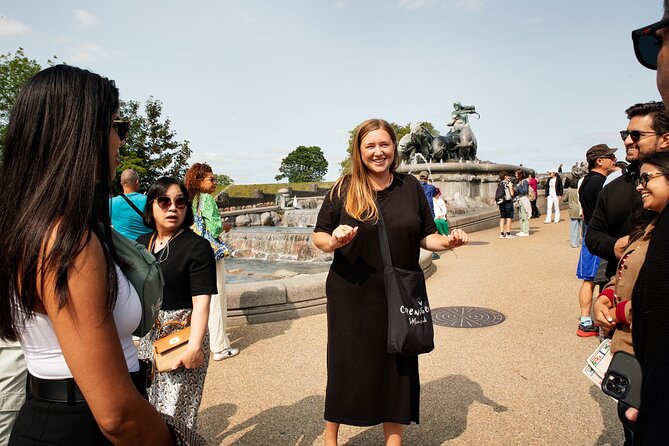
The first formal stop is the Gefion Fountain, one of Copenhagen’s most dramatic outdoor monuments. The fountain shows the Norse goddess Gefion pulling land from the sea with four oxen. The story connects to the traditional tale of how Zealand, the island where Copenhagen is located, came into being.
The guide uses this stop to introduce Danish mythology and the cultural stories Danes have carried for centuries. It is a useful early lesson because it shows that Copenhagen’s identity is not only about palaces and design. Old legends still shape the way the city presents itself.
The fountain sits beside Churchill Park, named in honor of the British wartime leader and dedicated to the heroes of World War II. This section adds a modern historical layer to the mythic opening. You move from gods and creation stories to occupation, resistance, and remembrance.
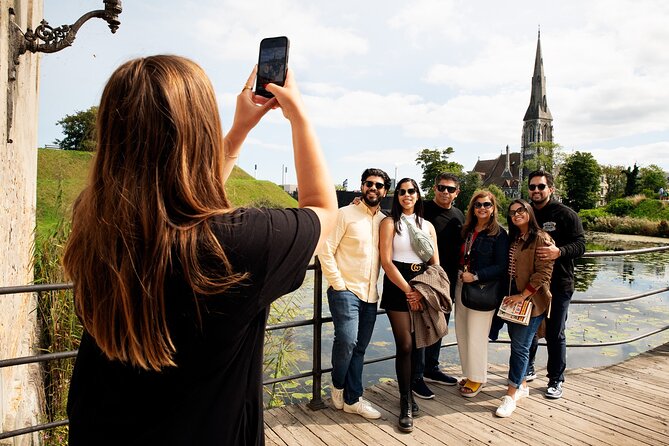
Nearby St. Alban’s Church gives you a quick look at a building unlike most churches in central Copenhagen. The tour only spends about five minutes here, so you should expect an exterior explanation rather than a long interior visit. That is typical of the whole walk: the guide gives you the reason a place matters, then keeps you moving.
The Citadel and Copenhagen’s military past
Next comes Kastellet, Copenhagen’s star-shaped citadel. From outside, its grassy earthworks and orderly paths can feel almost storybook-like, but the site had a serious military purpose. The tour uses the Citadel to explain Denmark’s long rise and decline, with stories reaching across more than 1,000 years of national history.
This is one of the more useful stops for putting Copenhagen into context. The city’s royal buildings and harbor views can make it seem polished and calm, yet its past includes warfare, shifting power, economic trouble, and national change. A good guide can make those broad themes understandable without turning the walk into a lecture.
You will not spend a long time exploring every corner of the Citadel. The schedule allows about 10 minutes, and the experience is designed around an outside view. If you want to walk the ramparts, inspect the buildings, or visit the museums in more detail, return later on your own.
The Little Mermaid, with a little skepticism
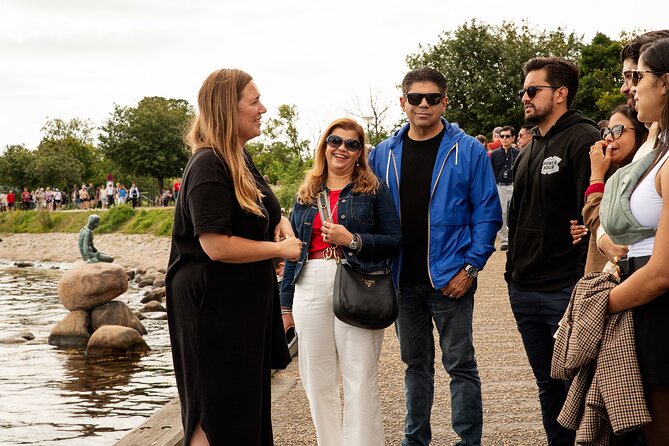
The Little Mermaid is the tour’s most obvious photo stop. You walk farther toward the harbor for a view of Copenhagen’s famous bronze figure, inspired by Hans Christian Andersen’s fairy tale.
The guide does more than point out the statue. You hear why the story and the sculpture are not quite as simple as the postcard suggests. That small dose of skepticism is welcome. Copenhagen’s most photographed attraction can be crowded and easy to reduce to a quick picture, but the tale behind it gives the stop more meaning.
Allow about 15 minutes here. That is enough time for photographs and a short explanation, though not enough for a long pause if the area is busy. You can ask the guide to help with a picture, a useful benefit in a small group where there is less awkwardness about handing over your phone.
The Little Mermaid is also one of the route’s practical limitations. It is farther from the central square where the tour ends, so the walk includes real distance rather than a series of nearby monuments. Bring supportive shoes, especially if you plan to continue sightseeing afterward.
More walking tours in Copenhagen:
- Private Walking Grand Tour of Copenhagen
★ 5.0 · 3,953 reviews - Copenhagen: Group Walking Tour – City Highlights – 2 Hours
★ 4.7 · 1,088 reviews - 3h walking tour, small group max 10 people Copenhagen
★ 5.0 · 686 reviews - Walk & Canal Tour: Copenhagen Highlights + Changing of the Guards
★ 5.0 · 580 reviews
Amalienborg and the Danish royal family
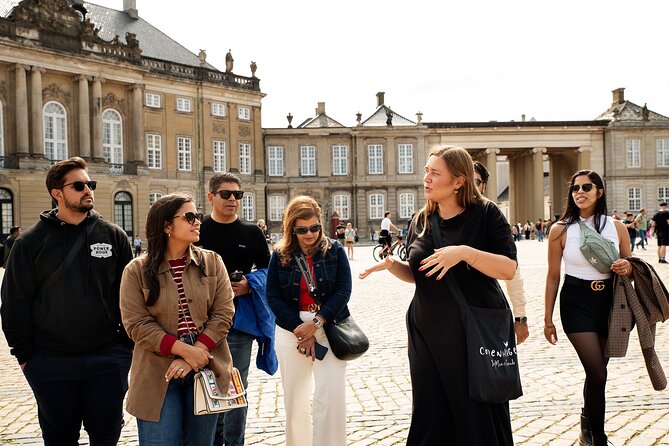
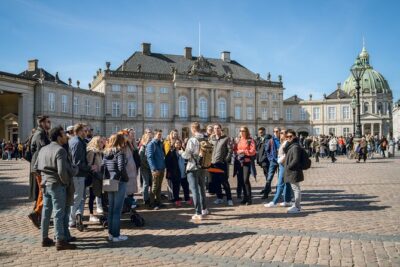
From the harbor, the walk turns toward Amalienborg, the working royal palace. This is where the tour shifts from fairy-tale literature to living Danish royalty.
You hear stories about the Royal Guard and about the royal family, including the current head of the family, referred to by the guide as Daisy. The tone is personal and informal rather than stiff. The guide also includes a small game about where the royal family member lives, giving the stop a lighter touch.
The tour does not include entry to Amalienborg Palace Museum. You see the complex from outside and learn how it functions as a royal residence. That is enough for an introduction, but you should plan a separate visit if palace interiors, royal rooms, and museum displays are high on your list.
The outdoor setting also helps you understand the palace’s arrangement. Copenhagen’s royal center is not hidden behind a huge private park. It is woven into the city, with streets, squares, churches, and harbor views close by.
Marble Church, Opera House, and the Royal Playhouse
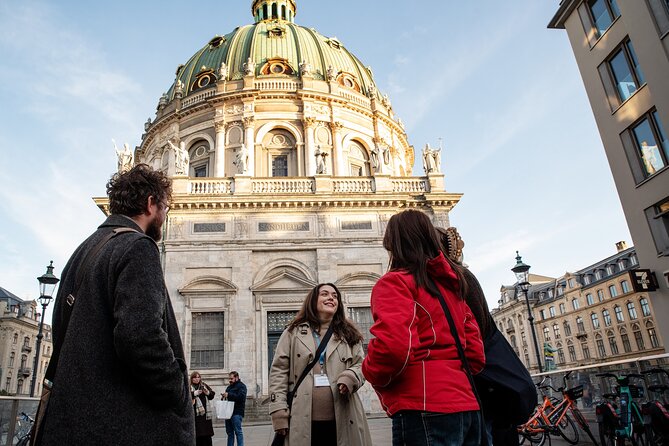
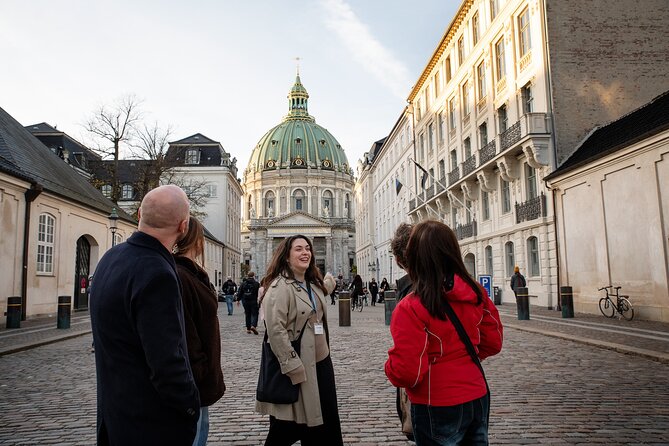
Amalienborg offers one of the route’s best architectural views: Frederiks Kirke, usually called the Marble Church, aligned with the royal palace. The church’s broad dome and pale stone make it one of Copenhagen’s most memorable buildings.
The stop lasts only about five minutes, but the alignment is worth noticing. This is a good example of why a guide helps. On your own, you might photograph the palace and church separately without realizing how deliberately they relate to each other.
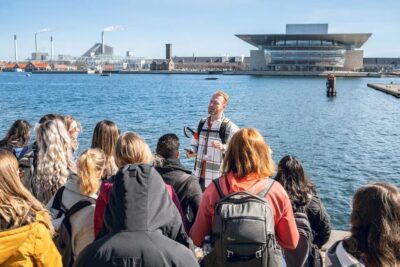
The route then moves through the gardens and toward Copenhagen’s Opera House across the harbor. The Opera House makes a strong contrast with the older palace district. You see the city’s royal past on one side and its modern cultural life on the other.
The walk continues by the Playhouse, the home of the Royal Danish Theatre. Here, the harborfront becomes part of the sightseeing. You are looking at performance spaces, canals, royal buildings, and public gardens in one compact area.
Amaliehaven, a small waterfront garden, provides another short stop. The guide explains why Copenhagen residents were not immediately pleased when these gardens and public spaces were first created. That kind of local reaction is more interesting than a simple date or architectural fact because it shows how a city changes, and how residents do not always welcome change at first.
Nyhavn from the best angle
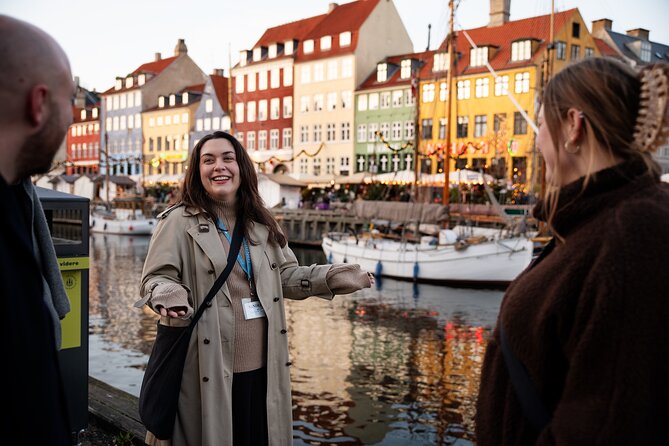
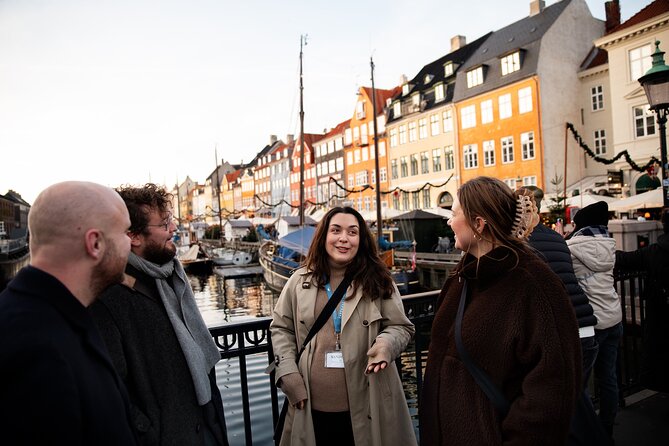
Nyhavn is Copenhagen’s most recognizable canal district, with colorful buildings, historic boats, restaurants, and narrow waterfront views. The tour approaches it from a particular viewpoint designed for photographs, rather than dropping you straight into the busiest stretch and moving on.
You get time to take pictures and hear about the harbor’s less polished past. Nyhavn’s bright facades now suggest cheerful cafés and weekend strolls, but the area grew from working waterfront life. The guide connects the attractive buildings to the people and trade that once gave the canal its purpose.
This is one of the places where a small group helps. The guide can suggest a good photo position and assist with pictures without losing track of a large crowd. You should still expect other people around, since Nyhavn is one of Copenhagen’s busiest public sights.
Do not confuse this stop with a meal break. Food and coffee are not included, and the walking schedule keeps moving. If you want to eat in Nyhavn, save that for after the tour or ask your guide for a nearby recommendation.
King’s New Square and Nikolaj Kunsthal
After Nyhavn, the route crosses Kongens Nytorv, or King’s New Square. This grand square brings together several parts of Copenhagen’s public life, including the Royal Danish Theatre, the city’s historic hotel tradition, and an early Danish shopping center.
The guide helps you read the square as more than an attractive open space. It is a meeting point between royal Copenhagen, commercial Copenhagen, and the city’s cultural institutions. This is also a good place to ask about shopping, restaurants, or areas to revisit later.
The walk then turns into smaller streets and looks up toward the spire of Nikolaj Church, now home to Nikolaj Kunsthal. The building is one of Copenhagen’s oldest churches, and its unusual use gives the stop a useful blend of old and new.
You do not get a long gallery visit here. The point is the exterior, the spire, and the story of how an old religious building became an art space. As with the other quick stops, you gain orientation rather than a complete museum experience.
Christiansborg and the end at Højbro Plads
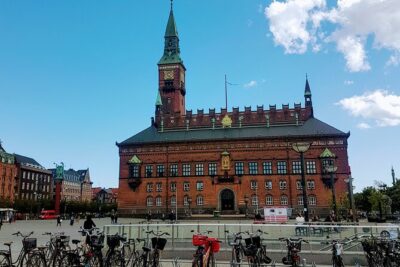
The tour finishes at Højbro Plads with a view of Christiansborg Palace. The building now houses the Danish Parliament, and the guide uses this final stop to discuss Danish politics and the country’s welfare system.
Ending here works well. You have moved from mythology and military history through royalty, theater, shopping, religion, and public government. Christiansborg brings those threads together in a place where Denmark’s political life is still active.
The tour ends in central Copenhagen beside the main pedestrian shopping street. That makes it easy to continue on foot, find lunch, shop, or return to a sight that deserved more time. The guide also offers one-on-one suggestions for further exploring the city, so save your practical questions for the final few minutes.
What the guides add
The guide can make or break a walking tour, and this experience has a strong record in that department, with a 4.9 rating from 361 reviews and 97 percent of customers recommending it.
Kenneth is praised for combining local knowledge with humor and for making a point of involving each person in the group. Oskar is described as dry and witty, with a good grasp of Danish history, culture, and current politics. Liva brings warmth, humor, and practical suggestions for shopping and food. Peter is especially attentive to groups with children and keeps the balance between history, culture, and everyday Danish life.
Other named guides include Sandra and Lukas. The important point is not that every guide will have the same style. It is that the experience is built around conversation, questions, personal stories, and local interpretation rather than a memorized list of dates.
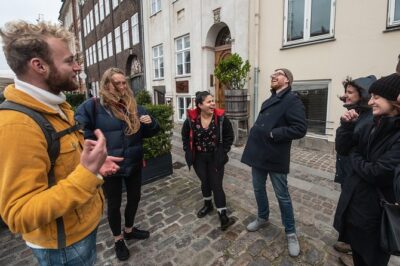
You should feel free to ask about food, politics, royal life, pronunciation, or places to visit later. The strongest part of this format is the direct exchange. With a maximum of 10 people, the guide has a fair chance to notice when someone has a question or needs a moment to catch up.
Pace, weather, and practical value
The listed duration is about two hours and 30 minutes, though the operator says the timing can vary between two and two and a half hours. The route is brisk. You should expect outdoor stops of roughly five to 15 minutes, followed by more walking.
Cobblestones and stairs are part of the experience. A moderate level of physical fitness is recommended, and comfortable footwear is essential. Copenhagen weather can turn wet, so bring an umbrella or rain jacket. The tour runs through parks, squares, waterfront areas, and streets, with no promise of shelter at every stop.
The price is $50.81 per person. I consider that fair for a small-group orientation, especially if this is your first visit and you want the city explained rather than simply photographed. You are paying for the guide’s time, route planning, local stories, and the chance to ask questions.
It is less useful value if you already know Copenhagen well or want lengthy interior visits. Admission is free at the listed stops, but the tour does not include museum or palace entry, coffee, meals, or gratuities. Think of it as a guided introduction that helps you decide where to spend the rest of your time.
Free cancellation is available up to 24 hours before the start time. Cancellations or changes made within 24 hours are not refunded, so keep that deadline in mind.
Who should book this walk?
I would book this early in a first Copenhagen visit, ideally near the beginning of your stay. The route gives you a map in your head, introduces the major sights, and ends close to places you can explore on your own.
It suits couples, solo visitors, families with older children, and anyone who prefers a personal small-group setting. It is also a good fit if you like history served with humor and local opinion rather than a formal lecture.
I would think twice if you want a slow pace, extensive time inside museums, or a route with very little walking. The many stops are a strength, but they also mean that each one receives only a short explanation.
Should you book it?
Book this Copenhagen walk if you want a lively first look at the city, a maximum group size of 10, and a guide who can connect royal stories, Danish politics, old legends, wartime memory, and daily life. The route covers the essentials without feeling limited to the usual postcard stops.
Skip it if you prefer to explore entirely on your own or want deep visits inside Amalienborg, Christiansborg, or other attractions. For most first-time visitors, though, the $50.81 price is a sensible way to get oriented, gather local recommendations, and see where you want to return.
FAQ
How long does the Copenhagen walking tour last?
The tour lasts approximately two to two and a half hours. The listed duration is about two hours and 30 minutes, but timing can vary.
What is the maximum group size?
The tour has a maximum of 10 travelers.
Where does the tour start?
It starts at ZinkGlobal by Kim Michael, Nordre Toldbod 12, 1259 Copenhagen, Denmark.
Where does the tour end?
It ends at Højbro Plads, 1200 Copenhagen, in the center of the city near the main pedestrian shopping street.
What language is the tour offered in?
The tour is offered in English by a native English-speaking guide.
Is coffee included?
No. You may buy coffee near the starting area at your own expense.
Are attraction admission fees included?
The listed stops have no admission ticket cost, but the tour is primarily an outdoor sightseeing walk. Entry to museums or interiors is not included.
What should I wear?
Wear suitable footwear for brisk walking on cobblestones and stairs. You should also bring an umbrella or rain jacket in case of rain.
Is the tour suitable for people with limited mobility?
The tour recommends a moderate physical fitness level and includes stairs, cobblestones, and a brisk pace. You should consider those conditions before booking.
Can I cancel for a full refund?
Yes. You can cancel up to 24 hours before the experience start time for a full refund. Cancellations or changes made less than 24 hours before the start time are not refunded.
Just added around Copenhagen
- Copenhagen Walking Tour with Food Testing (smorrebrod dish & snap)★ 4.5 · 10 reviews
- a day at North Zealand Castle Tour★ 4.5 · 19 reviews
- walking tour – Copenhagen and Christiansborg 3 hours★ 4.0 · 7 reviews
- Small Group Guided Food Tour and Street Art Visit to Norrebro★ 5.0 · 9 reviews
- The Philosopher’s Last Walk: An audio tour on the life of Søren Kierkegaard★ 4.5 · 5 reviews
- The Six Forgotten Giants Trolls Hunt with Minibus★ 4.5 · 27 reviews
- The Foodie Tour of Copenhagen★ 5.0 · 14 reviews
- The Forgotten Giants Private Tour★ 5.0 · 3 reviews
Walking Tours, compared.
Group Walking Tour – City Highlights – 2 Hours
Read our review →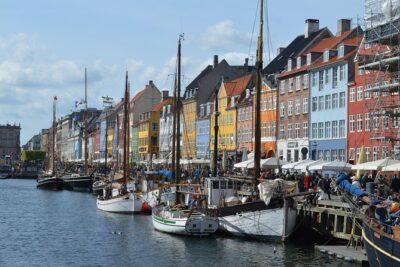
3h walking tour, small group max 10 people Copenhagen
Read our review →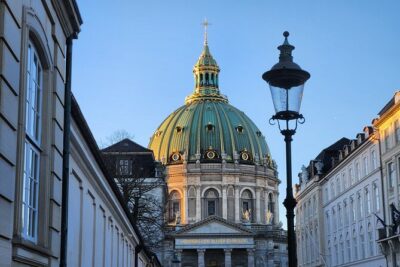
Walk & Canal Tour: Copenhagen Highlights + Changing of the Guards
Read our review →
Browse the lists this tour appears in